Eating 30+ Plants a Week Is Easier Than It Sounds

Updated: Aug 13

I have a habit of making healthy eating harder than it needs to be.
When I’m cooking at home, I really cook. I’ll roast a chicken and use the bones to make broth, turn that into chicken noodle soup, mix my own taco seasoning, make corn tortillas, grate the cheese, simmer spaghetti sauce and keep sourdough going when I’m on a sourdough kick. I love feeding my family that way, and I’ve always believed that what we eat plays a huge role in how we feel.
The problem is that there comes a point when cooking everything from scratch starts to feel like a full-time job. There’s always something to wash, chop, stir or clean, and somehow a wholesome homemade dinner can leave behind every bowl I own. Eventually I get tired, we start eating out more, and suddenly there are a lot more tacos, sub sandwiches and pizza in the week than I intended. Add my recent habit of about three Cadbury Caramello bars a week, plus homemade cookies, and things had definitely drifted.
Lately I’ve been feeling exhausted and dealing with some weight gain, and my sister’s upcoming wedding gave me an extra nudge to get back to taking better care of myself. I want more energy, less brain fog, better digestion, healthier-looking skin and, yes, I’d like my clothes to fit better too. But I wasn’t interested in making food even more complicated.
Then I started paying attention to something surprisingly simple : how many different plants I was eating in a week.
Why I Started Counting Plants
I’d been reading Plant Powered Plus by gastroenterologist Dr. Will Bulsiewicz because I was interested in the connection between food, gut health and the microbiome. One of the ideas that stuck with me was the importance of plant diversity. Rather than simply thinking about eating “more vegetables,” I started thinking about eating a wider variety of plant foods.
The 30-plants-a-week idea grew out of research from the American Gut Project, a large citizen-science study of the human microbiome. One of its findings was that people who reported eating more than 30 different types of plants each week had more diverse gut microbiomes than people who reported eating fewer than 10.
That caught my attention because different plants bring different things to the table. Fruits, vegetables, beans, whole grains, nuts, seeds, herbs and spices give us different types of fiber and a huge variety of vitamins, minerals and plant compounds. Blueberries aren’t doing exactly the same thing as black beans, and oats aren’t interchangeable with broccoli. Variety is the point.
I already love this kind of food, so I didn’t look at 30 and think, How am I ever going to eat all those vegetables? I love beans, grains, fruit, greens and vegetables. Last week I made it to around 25 different plants without being particularly organized about it. Thirty felt less like a daunting goal and more like a reason to pay attention.
Eventually, I’d love for 40 or even 50 different plants in a week to feel completely normal.
The Trick Is Adding, Not Overhauling
The biggest change has been surprisingly small. Instead of looking at a meal and wondering whether it’s healthy enough, I’ve started asking, what plant could I add?
That question is much easier to answer.
Breakfast is a perfect example. I made a normal bowl of oatmeal and added banana, blueberries, wild blueberries, blackberries, chia seeds, and hemp seed. It didn’t require a special recipe or much extra work, but suddenly an ordinary breakfast had several different plants in it.

Smoothies make this almost ridiculously easy. One of mine might have spinach, kale, banana, blueberries and dragon fruit, plus hemp, chia and flax seeds. That’s eight different plants in something I already like to make.
Soups and stews work the same way. A pot can easily have onion, carrots, celery, beans, tomatoes, greens, grains and herbs without feeling like you’ve made eight different foods. Big salads, grain bowls and tacos are just as useful because you can keep adding whatever makes sense.
Even something as simple as an afternoon snack starts to look different. Apple slices with blueberries and cinnamon gives me three plants without requiring any “healthy snack recipe” at all.
Once I started looking at food this way, 30 stopped sounding like a giant number. You aren’t sitting down in front of 30 vegetables and trying to finish them by Sunday night. They accumulate across breakfasts, snacks, smoothies, soups, salads and dinners all week.
My Grocery Haul Was About Adding Variety, Not Perfection
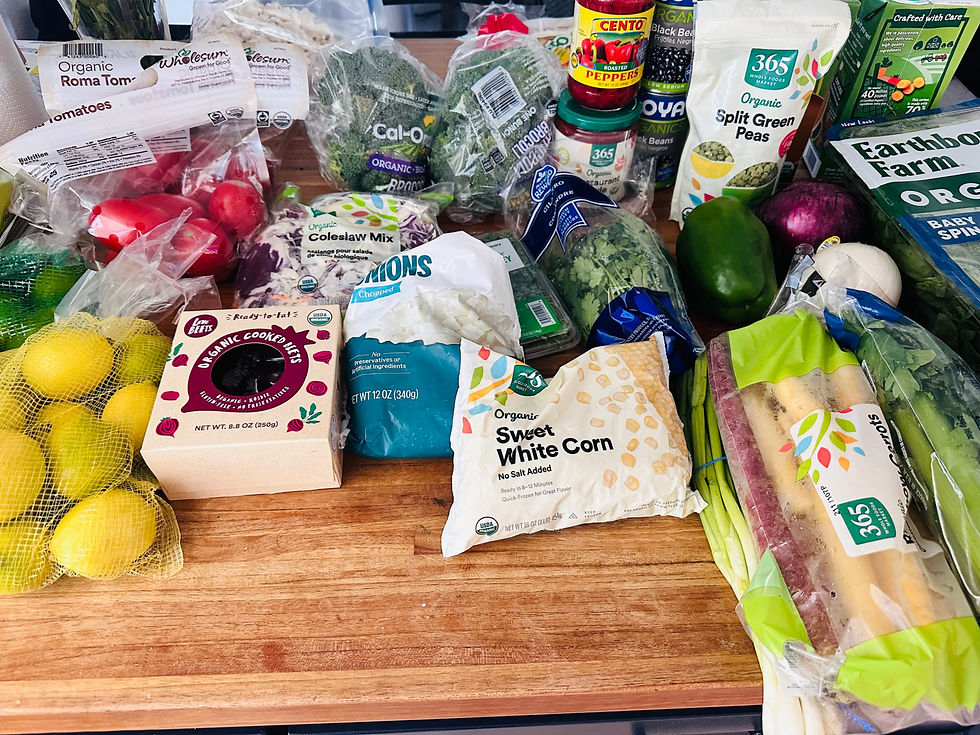
When I went shopping for the week, I wasn’t starting with an empty kitchen and buying 30 different plants just so I could check them off a list. I already had plenty of food in the refrigerator, freezer and pantry.
The grocery haul was about adding variety to what we already had.
I picked up different fruits and vegetables, greens, beans, herbs and other ingredients that could move easily between meals. Some were fresh, some frozen, some canned and some already prepped. That was intentional.
I’ve spent enough time cooking from scratch to know that the theoretically “best” option isn’t very helpful if I’m too tired to prepare it. I would rather buy regular carrots that are washed, cut and ready for me to grab than buy the perfect organic carrots, leave them untouched in the refrigerator because I don’t feel like prepping them, and end up eating chips instead.
Frozen vegetables count. Canned beans make life easier. Pre-cut produce can be worth it. Leftovers are welcome.
For me, eating better right now isn’t about proving how much work I’m willing to do for dinner. It’s about making the next choice a step better when I can.
And that may be the part of this I needed most.
The Little Things Count Too
The artichoke was probably my favorite example of how differently I’m starting to think about this.
I cut it in half and made a simple dipping butter with fresh lemon, garlic and parsley. Normally I wouldn’t have given those additions much thought beyond making the artichoke taste good. When you start paying attention to plant variety, though, you notice how easily those little ingredients accumulate over the course of a week.

That doesn’t mean I’m adding parsley to dinner so I can triumphantly announce another plant. I’m adding it because parsley, garlic and lemon make the butter taste better. The fact that flavor and variety can work together is exactly why this feels so manageable.
Herbs, spices, garlic, onions, citrus, salsa, seeds and toppings are easy to overlook, but they’re also some of the easiest ways to stop eating the same small rotation of plants every week.
This isn’t about finding Plant No. 29 on Saturday night and grimly eating a turnip.
It’s about noticing how much variety can already fit into food you actually want to eat.
The Tracker Is Weirdly Helpful
I started keeping a simple sheet to track what we were eating because I knew I wouldn’t remember everything by the end of the week. I expected it to be practical. I didn’t expect to enjoy it as much as I do.
Seeing the list fill up is oddly satisfying, but the more useful part is that it gives me a picture of the variety the whole family is actually getting over several days. Without tracking, it’s easy to think, We eat plenty of fruits and vegetables. But we could still be eating the same handful over and over again.
The sheet makes that visible.
If we’ve had bananas, apples and blueberries several times but no beans yet, I notice. If our dinners have been looking particularly beige, I notice. And instead of vaguely deciding that everyone needs to “eat healthier,” I have a much easier question to answer: What haven’t we had this week?
The funny thing is that keeping track hasn’t made food feel more complicated. It has made it simpler. Instead of counting calories or trying to grade every meal, I’m basically collecting plants throughout the week.
Apparently I’m highly motivated by checking things off a piece of paper. I can work with that.
This Is Making Healthy Eating Feel Less Complicated
This is the part I didn’t expect.
Because I care about ingredients and genuinely enjoy cooking, I can make healthy eating incredibly labor-intensive. If I’m not careful, my version of “doing well” means making everything myself. Eventually I get burned out by my own standards, and eating out becomes the easiest option.
Counting plants gives me a middle ground.
I can still roast the chicken and make broth from the bones when I want to. I can make tortillas or sourdough because I enjoy making them. But whether I had two hours available to cook dinner doesn’t have to determine whether I ate well that day.
Sometimes breakfast is oatmeal piled with fruit. Sometimes lunch is a giant salad. Sometimes I throw several plants into a smoothie and call that a very productive few minutes. Sometimes dinner is soup made from whatever needs to be used. And sometimes I’m tired at three in the afternoon and almond butter on a rice cake sounds perfectly good.
And sometimes it’s still going to be the Cadbury Caramello.
The difference is that one chocolate bar doesn’t need to become a verdict on the entire day.
I’ve noticed the same thing when we eat out. Restaurant meals can make getting a lot of plant variety harder simply because I’m full afterward and I’ve missed an easy opportunity to get several different plants into a meal. Now I notice that. Instead of thinking I’ve “blown” the day because we had pizza or sandwiches, I’m more likely to think about where I could have added something.
I like that way of thinking about food much better.
Why I Want to Keep Doing It
Gut health is what sent me down this road, but it isn’t the only reason I want more plants in my diet. I want more energy. I want less bloating and brain fog. I want to lose some of the weight I’ve gained, and I would absolutely like healthier, glowing skin.
A varied plant-rich diet gives us fiber along with vitamins, minerals and a wide range of plant compounds. Colorful fruits and vegetables also provide carotenoids and other phytonutrients associated with health throughout the body, including the skin. So while I’m interested in feeding the gut microbes, I’m also interested in what happens when I consistently give the rest of my body better raw material.
What I particularly like is that none of this requires me to suddenly become someone who spends Sunday afternoon filling 21 matching meal-prep containers.
I’m not replacing everything in my kitchen or trying to make seven days of perfect meals. I’m keeping good food around, making plants easy to grab, piling several into meals when it makes sense and keeping track as I go.
Thirty plants in a week sounds impressive until you realize a smoothie can have eight and a bowl of oatmeal can knock out several more before breakfast is over.
Then it starts to feel less like a health challenge and more like a very doable way to eat.
I’m going to keep counting and see where I land this week. I’m also curious about which foods we actually finish, what gets left behind, how eating out affects the week and what I notice about how I feel.
But I already know one thing: 30 plants doesn’t feel hard.
It has actually made eating well feel simpler. And honestly, I’m already thinking about 40+ plants a week.
Comments